
Battalla is a tactical TCG where you play as the commander of an army of characters from various Mythologies. Your goal is to invade your opponent's side of the field and attack their life cards.
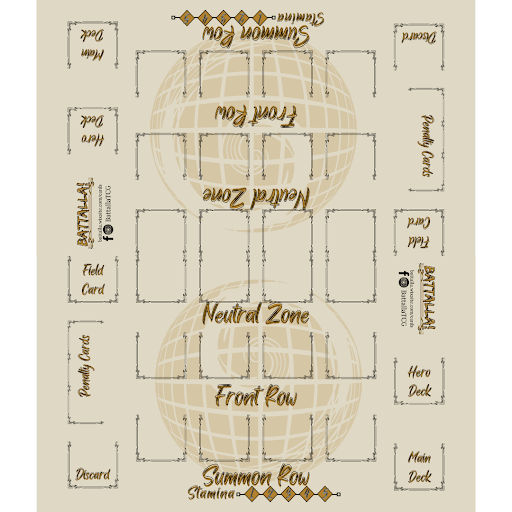
Both players will start with a Main Deck (MD) of 40-60 cards and a Hero Deck (HD) of 5 unique Hero cards. Players can have up to 3 copies of each card in their main deck, and can use cards from any mythos so long as they have a Hero from that mythos in their Hero Deck.
The Main Deck should be shuffled and placed face down. The Hero Deck is not shuffled and is placed face up in whatever order you choose.
After both players have shuffled their Main Deck and decided on the order of their Hero Deck, they can decide who goes first (usually by rolling a die or flipping a coin).
Both players draw 5 cards off the top of their deck. Players have the option to take any number of cards from their opening hand and put them on the bottom of the deck, then draw the same number of cards.
Once both players have their opening hand, both players take the top 5 cards of their deck and place them face down in their "Life Zone." When a player attacks directly, the defending player will add a card from their Life Zone to their hand. A player loses the game when their Life Zone has zero cards.
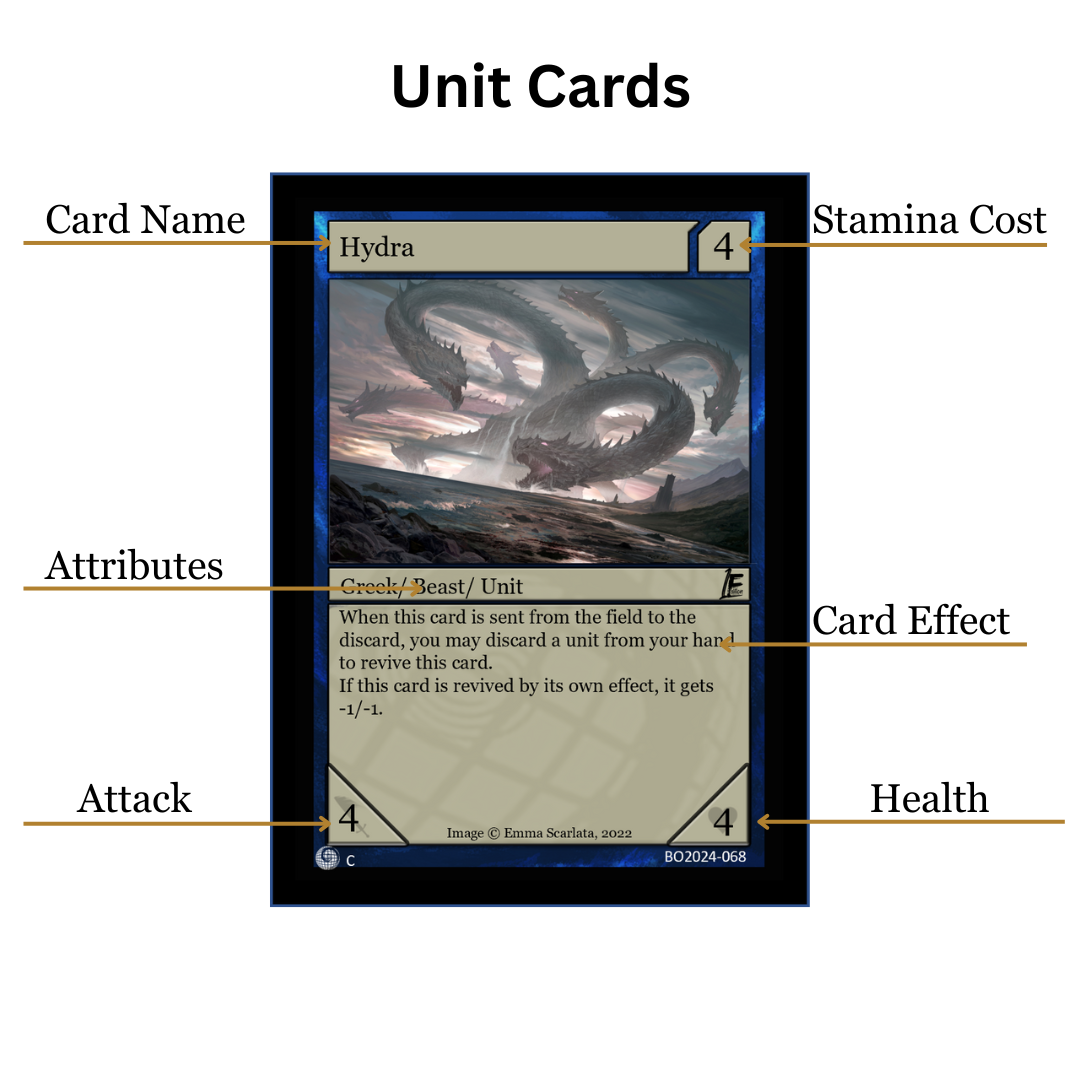
Units are played in the summon row and can move forward each turn. A unit cannot be played in a lane where you already control a unit (this is referred to as "Lane restrictions"). Cards can be moved into a lane behind a card you control.
Note: Units can exist in the Hand, Main Deck, Field, or Discard.
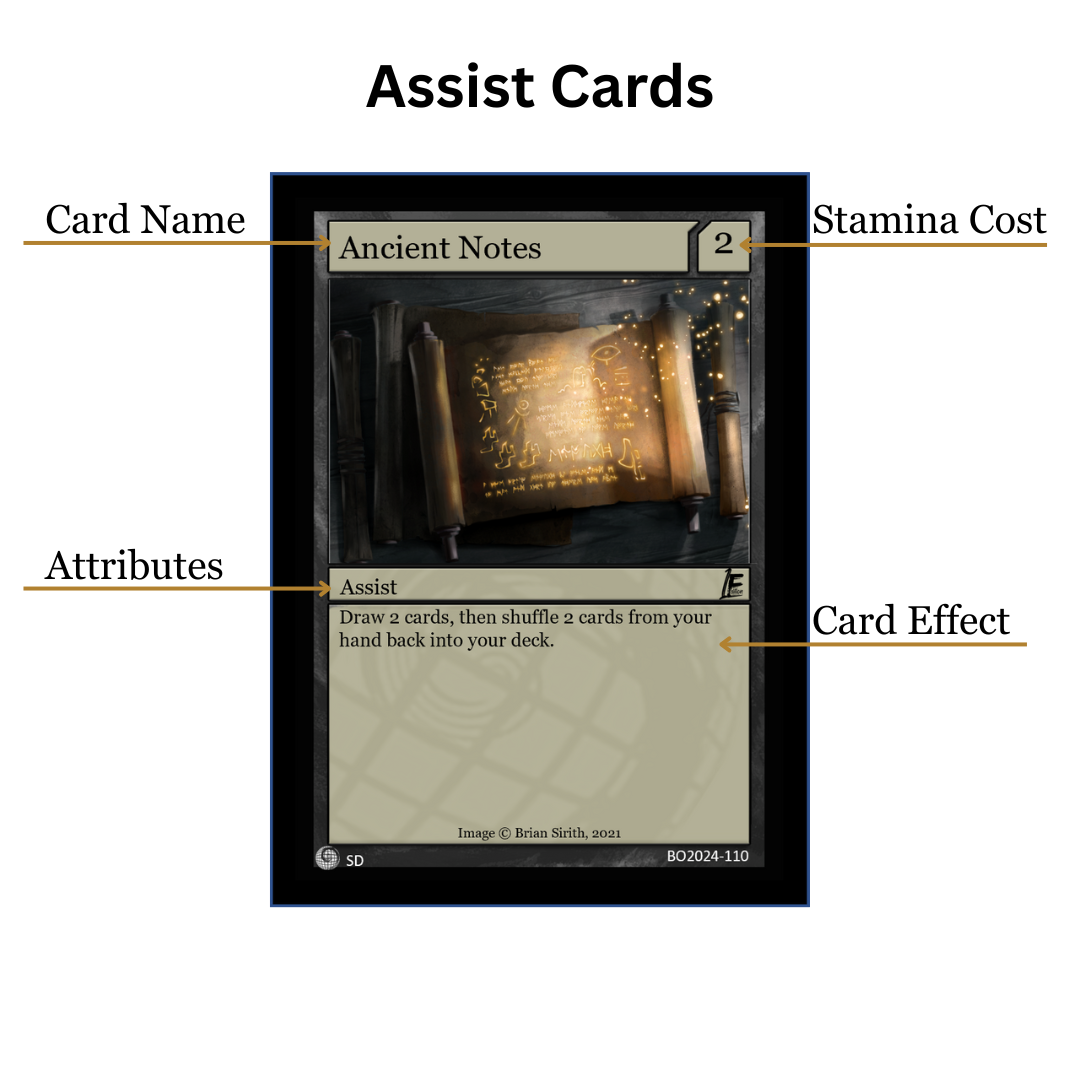
Assist cards can be played from the hand during your turn. To play an assist card, pay the stamina cost of the card and show it to your opponent. Activate the effect, then place the assist in the discard once its effect is resolved.
While the effect is resolving, the Assist is considered "Floating" and is neither considered in the hand nor in the discard (it is also not considered to be on the field).
Item Tag: Some cards have the "Item" tag. If a card is played as an item, it loses any attributes beyond its mythos and the "item" tag. When played, Items are attached to other cards on the field, giving these cards a new effect (listed under "Attached" on the item card). Items can be attached to any card on the field, regardless of who controls them.
Note: Assist can exist in the Hand, Main Deck, Discard, or Field when effects specify (such as attach effects allowing them to be on the field as long as they are attached to a unit or hero).
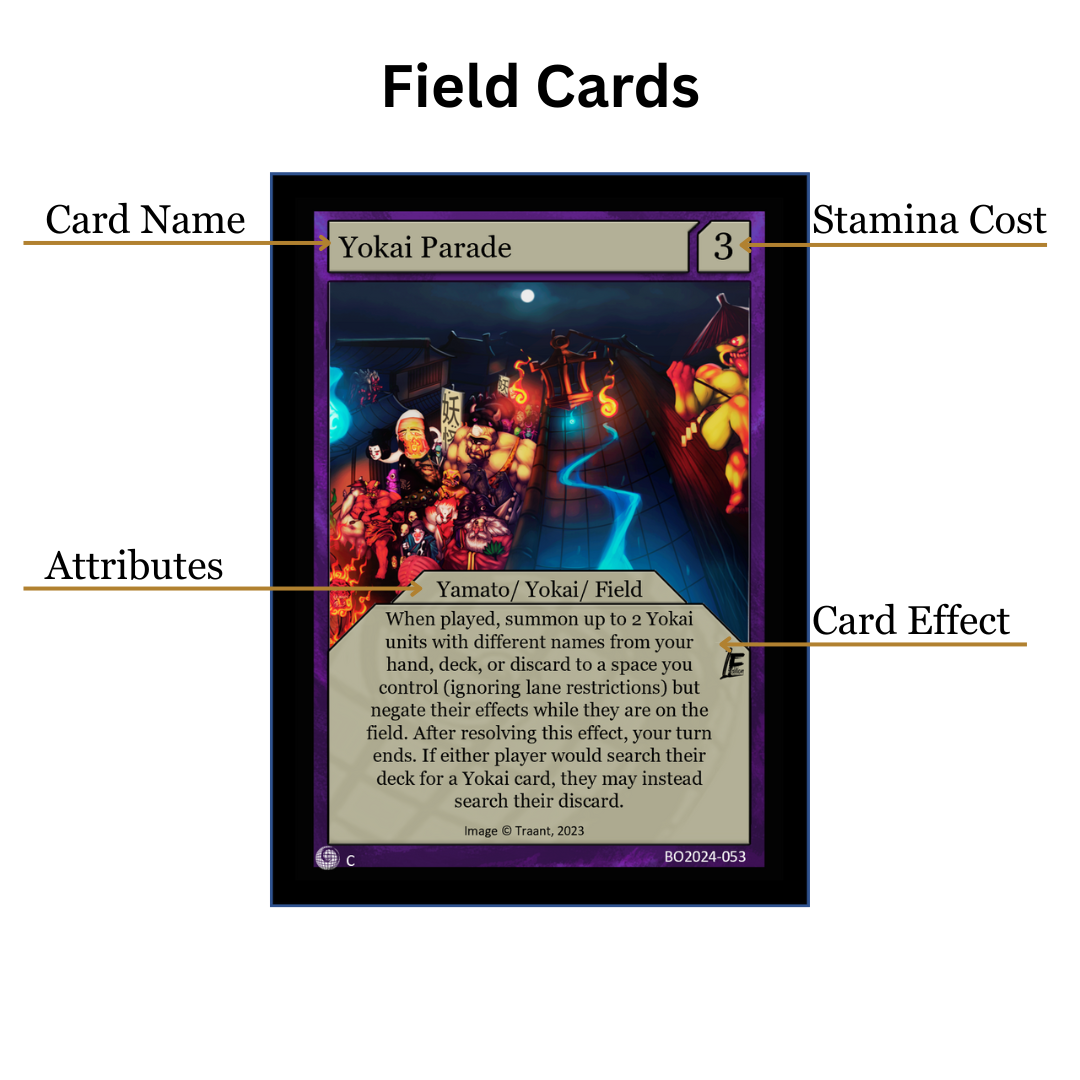
Field cards are played in the "Field Zone" and affect both players. Only 1 Field can be active at a time; if a new one is played, the previous one is discarded.
Note: Field cards can exist in the Hand, Main Deck, Discard, or Field Zone.
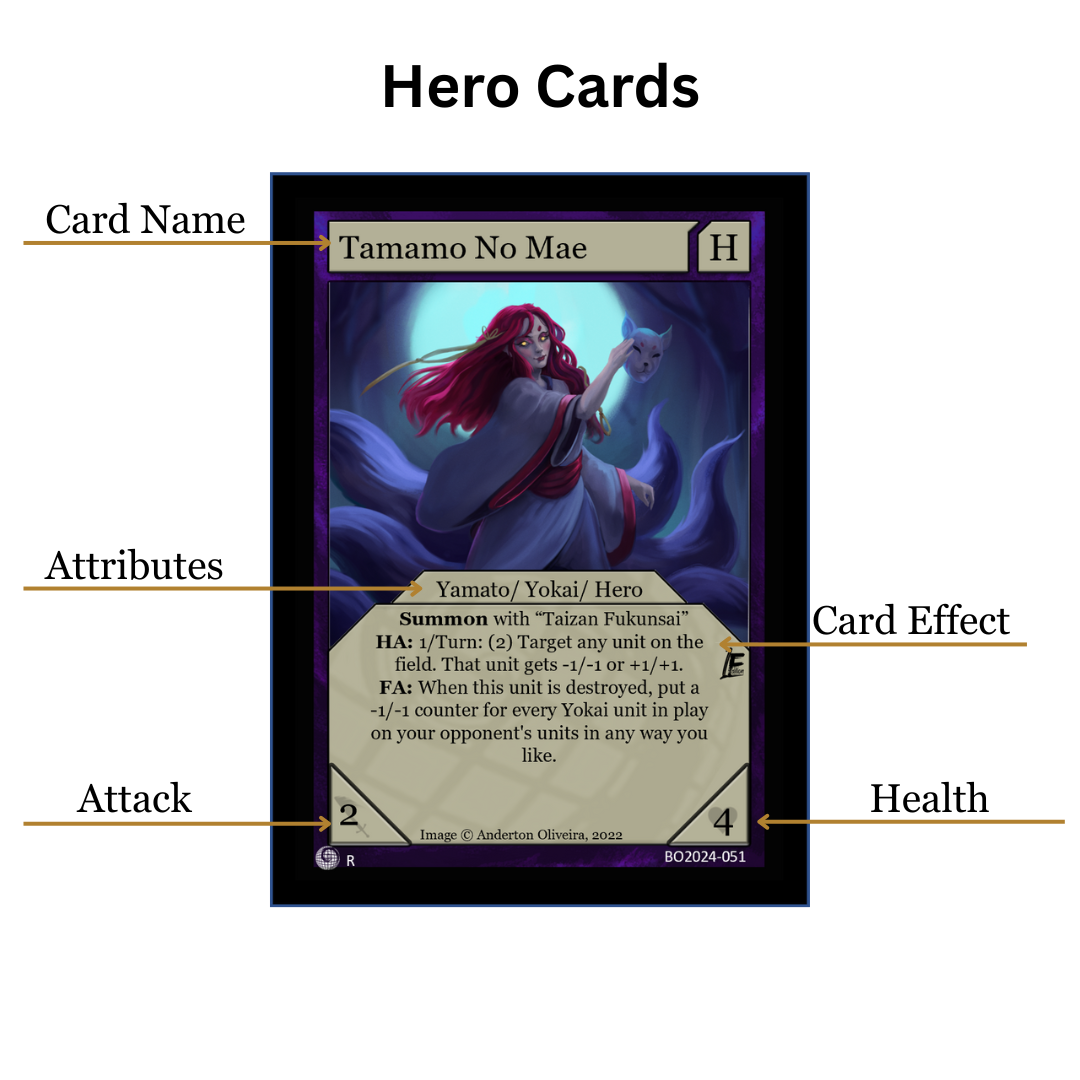
Hero Cards are powerful cards that function similarly to Units. Hero cards are placed in the HD in whatever order the player wishes at the start of a game. Heroes have 3 written abilities:
Important: Units and Heroes are different card types. Cards that target Units only CANNOT target heroes.
Note: Heroes can exist in the Hero Deck, Field, or Discard.
In rare cases, card effects will force a card to exist in a place it cannot exist. If this happens, the card is destroyed and sent to the discard instead.
The Battlefield consists of 5 rows and 4 lanes. The rows are:
The main goal of Battalla is to move your units and heroes across the field to attack your opponent's life cards.
Cards that are in the summon row can move sideways. Once a card moves out of the summon row, it is "Locked in" and can only move forward unless an effect says otherwise.
Units or Heroes can move once per turn for (1) stamina.
Cards cannot move into a space occupied by another card. If cards are forced to enter an occupied space by any mechanic or effect, the card entering an occupied space is destroyed.
At the start of each turn, a player is granted 5 points of Stamina. Stamina is the resource you will use to play cards, move cards, and attack opposing cards. Each unit or Hero can move and attack 1 time each turn, and each action costs (1) stamina. Because there might still be actions you can make without stamina, such as summoning a Hero, you must declare your turn over when you are out of actions you wish to make.
Each card you control can declare 1 attack each turn, for (1) stamina. Cards can attack an opponent's card that is in a space directly in front of them. If you control a card in your opponent's Front Row, that card can attack your opponent's life cards.
When you declare an attack against an opponent's card, subtract your card's attack value from the opposing card's health value. Below is a detailed breakdown of a battle:
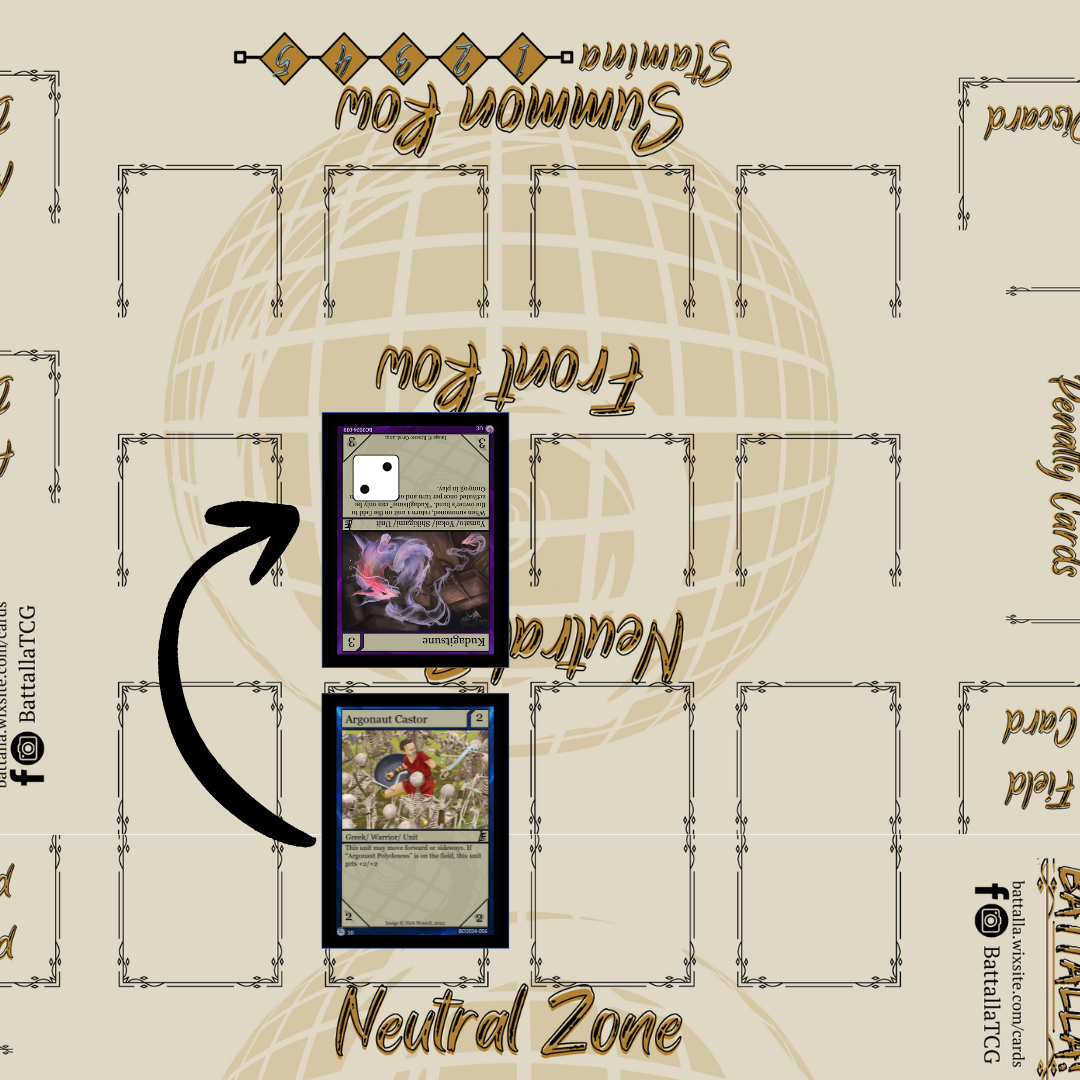
Example: The turn player attacks with Argonaut Castor. Since neither card has an effect that activates during a battle, Castor will deal 2 damage to Kudagitsune (typically tracked with dice). Kudagitsune is left with 1 Health. Damage persists until a card is healed or leaves the field.
If you control a card on your opponent's side of the field (either in their Front Row or Summon Row), that card can attack your opponent directly. To do so, declare a direct attack. As long as the attacking unit has an attack value of 1 or more, the opponent will draw a card from their Life Zone and add it to their hand.
When an effect is activated, it opens a Storyboard. Cards with the "React" keyword can be added to the storyboard by either player. Effects on the storyboard resolve in reverse order of how they were added.
Sometimes, effects can be triggered when paying the cost for an effect or during resolution of the Storyboard. In this case, the new effect is added to the END of the storyboard. If two effects are added at the same time, the turn player has priority and will resolve first (added to the storyboard 2nd). If 2 effects are added at the same time by the same player, that player chooses the order to resolve these effects.
Keywords are effects represented by a single word or phrase. Usually, these will be in bold to help them stand out. Currently, the game has the following keywords:
Sacrifice: Send a Unit or Hero you control from the Field to the discard.
Discard: Send a card from your hand to the discard pile.
Revive: Summon a card from the discard, then give it the "Revived" attribute.
(#): Activating this effect costs # stamina.
Attached: This effect is given to a card this card is attached to.
React: This effect can be activated on your opponent's turn, as a response to an action they take or ability they activate.
Replace: Send a card to the discard and place the new card in the same space. The new card retains all boardstate counters and attachments from the replaced card. This does not count as summoning that card.
Surprise: This card may attack on the turn it is summoned.
A boardstate counter is any counter that stays on a card while it is on the field. Boardstate counters include the following:
Any counter that would take a card's value BELOW zero has no effect and is removed from the card. This is most relevant with attack counters (-1/-0).
Cards cannot attack unless their time on the field counter is greater than 1 turn.
Players cannot activate an effect that would force a card to exist in an area it cannot exist. For example, if you play Ankh to return 3 cards to the deck, you cannot target a Hero card since it cannot exist in the Main Deck.
Some interactions might break this rule, so as a reminder, if a card ever exists in an area it is not allowed to exist, it is placed in the discard.
Example: A unit under the effect of Potion of Immortality is treated as a hero and can be the target of Funnmach's Scheme. In this case, when the unit is returned to the Hero Deck it will lose the effect of Potion of Immortality and no longer be considered a hero. Because units cannot exist in the Hero Deck, the unit is placed in the discard.
Cards have attributes that group them into specific categories. Assist cards do not take up space on the field, Hero cards must start the game in the Hero Deck, Field cards must be played in the field zone, and Unit cards must be played in the summoning row.
Aside from these 4 main card types, "Item" is a special attribute given to any card that can be attached to another card. Assist cards can always be attached from the hand, but unit or hero cards that have the "Item" attribute must be attached by their own effect.
Other Attributes, such as "Fae," "Greek," or "Warrior" group cards into specific archetypes and sub-archetypes. These attributes might be important for certain card effects, so be sure to pay attention to them.